

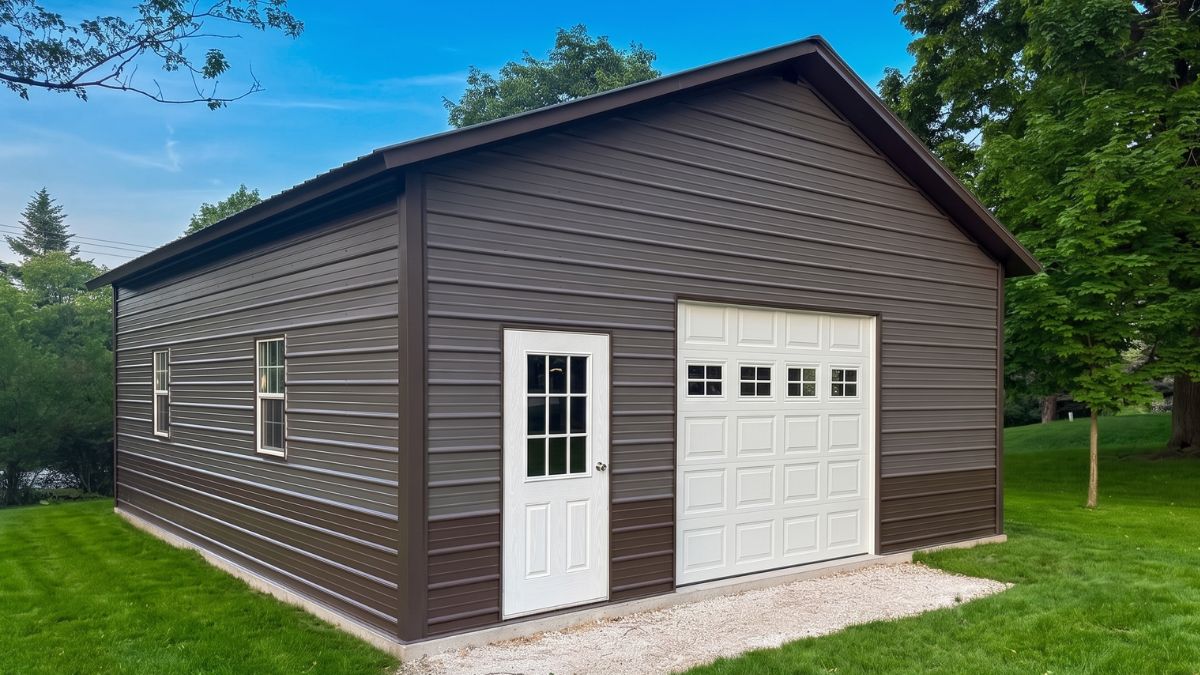
A detached garage or carport is one of the few outbuildings that show up on the appraisal in a way buyers actually understand. For homeowners who need covered parking, workshop space, or simple storage, a steel structure built on a solid concrete pad has become the most common way to add square footage without undertaking a full stick-built addition. The numbers behind that choice are worth understanding before any homeowner signs a contract, because the gap between metal garages and conventional construction is wider than most first-time buyers expect.
This article looks at what detached metal garages and metal carports do for home value, how the cost compares to a stick-built equivalent, how to size the structure for one to three vehicles plus storage, and the zoning issues that quietly kill projects after the slab is poured.
How Detached Garages and Carports Move an Appraisal
Appraisers give the most weight to covered, lockable square footage on a permanent foundation. Industry guidance from the Appraisal Institute treats detached garages as a contributing improvement, valued by comparison to recent sales of similar homes with similar outbuildings. A fully enclosed garage with a concrete slab, a permitted electrical run, and a closed roof typically returns 60 to 80 percent of its build cost at sale in most US markets. Open carports return less, often 40 to 60 percent of build cost, but they cost so much less to build that the dollar gap between cost and recovered value is usually smaller than a garage’s.
The National Association of Home Builders has reported for years that off-street covered parking is one of the top three features buyers ask for in suburban and rural markets. A house with two covered spaces sells faster than a house with none. A house with a workshop or RV space attached to the parking area sells to a wider buyer pool because it attracts tradespeople, hobbyists, and small business owners alongside conventional family buyers.
Cost Compared to a Stick-Built Equivalent
A standard 24-by-24 stick-built detached garage costs $35,000 to $55,000 across most US markets in 2026, with the higher end common in coastal metros and union-labor states. A comparable 24-by-24 pre-engineered metal garage with a concrete slab typically lands between $18,000 and $28,000 installed. The shell alone, without a slab, runs $9,000 to $14,000. The savings come from a smaller framing labor crew, factory-pre-cut panels, and a faster installation window of three to seven days for the structure itself.
The numbers shift further on open carports. A 20-by-20 stick-built open carport with a shingled gable roof runs $8,000 to $15,000 in most regions. A pre-engineered 20-by-20 steel carport typically costs between $1,800 and $3,800 installed before slab. Even with a concrete pad added, the all-in price usually clears under $7,000 in non-coastal markets.
| Structure | Stick-built installed | Pre-engineered metal installed | Typical install time |
| 20×20 open carport | $8,000 to $15,000 | $1,800 to $3,800 plus slab | 1 to 2 days |
| 24×24 enclosed garage | $35,000 to $55,000 | $18,000 to $28,000 with slab | 3 to 7 days |
| 30×40 garage shop | $70,000 to $110,000 | $32,000 to $48,000 with slab | 5 to 10 days |
Concrete is the line item that most homeowners underestimate. A properly engineered garage pad with thickened edges and a vapor barrier runs $6 to $10 per square foot in most markets, and the slab usually lives outside the steel quote.
Sizing for One to Three Vehicles Plus Storage
The most common mistake on a first detached garage is sizing the building for the car instead of the car plus the door, walking space, workbench, and rolling toolbox. A sedan needs about 16 feet of length and 9 feet of width to park comfortably. A full-size pickup with a crew cab and a five-and-a-half-foot bed needs closer to 22 feet of length and 10 feet of width before you can open the door without scraping a wall.
- One vehicle plus light storage. 18 by 20 minimum. 20 by 24 is more comfortable and adds room for a workbench and a riding mower.
- Two vehicles plus storage. 24 by 24 is the national workhorse size. 24 by 30 gives a usable shop bay behind the second vehicle.
- Three vehicles or two vehicles plus a real workshop. 30 by 40 is the practical sweet spot. It fits three full-size pickups end-to-end or two trucks with a 10-foot shop bay across the back.
- RV or boat plus daily drivers. 14-foot sidewall minimum on the structure for a Class C motorhome. 16-foot sidewall for a fifth wheel or Class A. A roll-up door at least 12 feet wide and 13 feet tall.
Sidewall height is the variable most homeowners forget. A 9-foot sidewall is fine for sedans and small SUVs. A 10-foot sidewall is the floor for a full-size pickup with a roof rack or a kayak overhead. A 12-foot sidewall is the minimum for a lift, and most home mechanics regret going shorter once they price a two-post lift.
Zoning, Setbacks, and Permit Gotchas
The zoning issues that kill detached garage projects rarely show up in the marketing brochure. A homeowner needs to verify five things before signing any contract.
- Setback distances. Most jurisdictions require 5 to 10 feet from side and rear property lines, sometimes more for accessory structures over a given footprint. A 30-by-40 garage on a narrow suburban lot can fail setback rules that a 24-by-24 would clear.
- Maximum accessory structure footprint. Many counties cap accessory buildings at a percentage of the lot size or at a hard ceiling, such as 1,000 square feet, without a special permit.
- Height limits. Suburban zones often cap accessory structure height at 15 to 18 feet to the peak. A 12-foot sidewall with a 4-to-12 roof pitch can clear that easily on a 24-foot-wide building but fail on a 40-foot-wide one.
- HOA restrictions. HOAs sometimes prohibit metal siding outright or require specific roof colors and pitches. A homeowner needs a written sign-off from the architectural review committee before the order goes in.
- Wind and snow load engineering. Coastal counties from Texas to Maine, plus mountain counties in the West, require stamped engineering for the wind- or snow-load zone. Buyers in those zones should confirm that the supplier ships a sealed engineering package with the building.
The other quiet killer is the driveway. A new detached garage usually needs a new driveway extension, and concrete drive work in most markets runs $8 to $14 per square foot. A 100-foot extension to the new garage location can add $10,000 to $20,000 in costs that fall outside the building budget.
Where Metal Does Not Win Every Time
Steel is the right call on most detached garages and almost every open carport, but it is not universal. HOAs that require lap siding and shingled roofs to match the main house can push a project back toward stick-built or toward a steel shell with wood and shingle finishes layered on. Garages with finished interior living space above, like a garage apartment, usually pencil better as conventional construction once the upper floor finish, stairs, and second-story window framing are priced in. Historic districts often prohibit pre-engineered metal siding outright.
For straight covered parking and workshop use, a pre-engineered metal garage or a simple steel carport usually delivers the same usable square footage for 40 to 60 percent of the conventional build price. Companies that handle their own delivery and installation on the shell make the cost gap even wider, because the installation labor that drives stick-built pricing disappears from the homeowner’s invoice.
The Bottom Line for Homeowners
A detached metal garage or a steel carport adds resale value, broadens the buyer pool, and costs roughly half as much as a stick-built equivalent. The discipline lies in sizing the structure for the vehicles and the workspace, in pricing the concrete slab and driveway as separate line items, and in clearing setback and HOA rules before the building is ordered. Done right, the project lands in the 60 to 80 percent cost recovery range that appraisers treat as a real improvement, and the family gets covered parking, storage, and workshop space for years before the house ever goes back on the market. Metal carports are the entry point for homeowners who only need covered parking, and detached metal garages are the upgrade for anyone who wants a lockable, enclosed building on the same lot.
About the Author
Logan Hermer is the Senior Construction Editor at Metal America, an American-made metal construction company headquartered in Austin, Texas. He has written more than 200 articles covering metal buildings, carports, barndominiums, garages, concrete, and commercial steel structures.
