
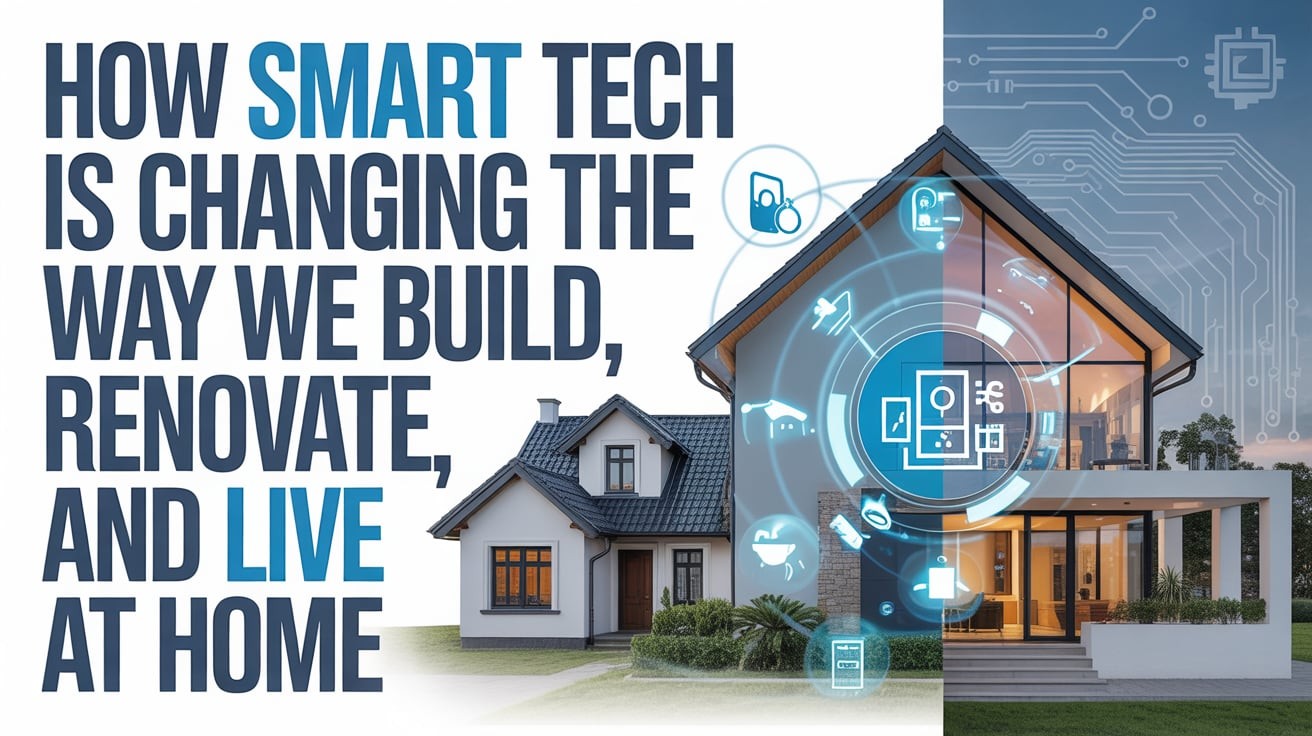
Smart home technology is a set of connected systems, devices, and software that enable a home to sense, respond, and adapt to its inhabitants’ needs. Everything from thermostats to lighting to building components is becoming smarter, and the impact is visible in how we design, build, renovate, and operate modern homes.
A recent industry estimate suggests that more than 60 billion connected devices are active worldwide, and a fast-growing share now belongs to residential environments rather than commercial or industrial sites.
This shift matters because smart tech influences early planning stages of a renovation, the materials builders choose, and the long-term efficiency and comfort homeowners experience.
In the sections below, you will explore what smart home technology means in today’s housing market, which tools shape modern construction, how automation improves energy performance, and what future trends will define the next generation of homes.
What Does Smart Home Technology Mean in Today’s Housing Market?
Smart home technology is a digital ecosystem of sensors, controllers, connected appliances, and cloud platforms that automates and optimizes a home’s performance.
In today’s housing market, this ecosystem is no longer a luxury feature reserved for high-end properties. Instead, it is increasingly seen as a core component of modern living, as buyers expect homes to offer greater convenience, efficiency, and flexibility.
This shift affects how architects and builders plan their work.
Smart wiring, structured networks, automated shading, and intelligent HVAC controls are becoming standard considerations early in the design process.
Real estate listings now highlight smart thermostats, app-controlled locks, and adaptive lighting in the same way they once highlighted premium countertops or upgraded appliances.
The market is signaling that connected living is the new baseline rather than a futuristic add-on.
What Types of Smart Technologies Are Reshaping Home Construction and Renovation?
Smart home technologies are categories of interconnected systems that bring automation, sensing, and digital control to the building environment.
They work together to make a house more responsive, efficient, and personalized.
Rather than relying on isolated devices, modern homes increasingly use coordinated platforms that unify lighting, HVAC, shading, appliances, and energy management.
Some of the main innovative technology types reshaping construction today include:
- Building automation systems
- 3D printing and additive manufacturing for components
- Smart lighting systems
- Intelligent energy management tools
Building Automation Systems
A building automation system is a centralized digital platform that monitors and manages environmental conditions such as temperature, ventilation, light, and air quality.
In homes, automation platforms serve as the coordination layer, integrating thermostats, occupancy sensors, window controls, and smart vents into a single operating logic.
They are automatically applied to maintain comfort, reduce wasted energy, and allow homeowners to adjust settings remotely.
Their working principles rely on sensors collecting real-time data and controllers comparing those readings to setpoints.
Commands are then sent to equipment such as heat pumps, boilers, and fans to maintain stable indoor conditions.
Through a simple smartphone interface, homeowners can fine-tune how their environment responds throughout the day.
3D Printing and Additive Manufacturing for Home Components
3D printing is a digital manufacturing technology that builds objects layer by layer from materials such as plastic, resin, or metal.
In construction and renovation, 3D printing can be used to create customized fixtures, replacement parts, and design prototypes that would otherwise require complex machining.
Its main applications include printing brackets, vents, trims, and decorative architectural elements that match unique dimensions.
The working principle begins with a digital model sliced into layers.
A printer then deposits or cures material sequentially to form the final object.
This approach helps designers iterate faster and reduces delays when unusual parts are needed.
Modern residential projects now leverage professional 3D printing technology to accelerate prototyping and customization in renovation workflows.
Smart Lighting Systems
A smart lighting system is a collection of LED fixtures, occupancy sensors, dimmers, and digital controls that automatically adjust brightness and color.
These systems can be used in homes to improve mood, highlight architecture, and reduce electricity consumption.
Typical applications include adaptive downlighting, tunable white LEDs, and app-controlled accent lighting.
The working principle pairs LED hardware with wireless communication, enabling lights to respond to presence, schedules, or scenes.
Instead of static fixtures, homes receive dynamic lighting that adapts to daily rhythms.
A growing number of homeowners and designers are turning to advanced LED lighting technology to integrate more expressive, efficient lighting concepts directly into renovation plans.
Intelligent Energy Management Tools
Intelligent energy management tools are digital platforms that track and optimize electricity use.
They can be used to coordinate HVAC systems, solar inverters, battery storage, and controllable appliances.
Common applications include shifting loads away from peak pricing, monitoring usage in real time, and recommending energy-saving adjustments.
These tools rely on sensors and smart meters feeding data into cloud software that analyzes patterns.
With automation enabled, they can pre-cool spaces before temperature spikes or pause certain appliances automatically during peak tariff windows.
How Are Modern Tools and Machines Changing Home Renovation Workflows?
Modern tools and machines are digital fabrication and automation systems that bring industrial precision into home renovation projects.
They change workflows by allowing contractors to build customized pieces faster, reduce installation errors, and rely on data rather than guesswork.
Designers increasingly work from digital models that translate directly into manufacturing, supporting cleaner project coordination.
This shift allows more prefabrication, shorter project timelines, and improved repeatability.
When fixtures are made using controlled equipment rather than manual cutting, the results are more accurate and easier to integrate into smart home layouts.
Renovations become less about improvisation and more about precision assembly.
CNC Machines for Custom Home Fixtures
A CNC machine is a computer-controlled cutting tool that shapes materials according to programmed instructions.
In renovation, CNC tools are usable for cabinetry, wall panels, and decorative features with precise geometric details.
Typical applications include routing patterns, drilling perfect alignments, and cutting complex shapes for architectural elements.
Their working principle converts a digital drawing into toolpaths executed by motors and cutting tools.
Because CNC systems follow these instructions exactly, they reduce human error and deliver high repeatability.
Waterjet Cutting for Architectural Features
Waterjet cutting is a subtractive manufacturing process that uses a high-pressure stream of water mixed with abrasive material to cut through stone, metal, glass, and concrete.
It is usable in homes to create intricate tile inlays, stone countertops, or custom metal panels.
Waterjets excel in applications that require clean edges, minimal heat, and incredible detail.
Since the process generates no heat-affected zone, the structural integrity and appearance of decorative pieces remain intact.
Builders use waterjet-cut components to achieve tighter tolerances and smoother integration with smart lighting, automation modules, and energy-sensing devices.
What Are the Main Advantages of Using Smart Tech in Building and Renovation?
Smart technology delivers practical benefits from the moment it is installed.
It improves comfort, increases energy efficiency, and elevates the functionality of every room.
These improvements are most visible when systems work together rather than in isolation.
Six key benefits illustrate why smart homes continue to grow in popularity:
- Improve comfort through responsive heating, cooling, and lighting
- Reduce energy bills with optimized operation
- Increase security through smart locks and cameras
- Simplify maintenance using alerts and diagnostics
- Boost resale value with desirable smart features
- Personalize spaces with scenes and automation
Are There Any Limitations or Challenges When Integrating Smart Tech?
Smart home technology brings challenges that homeowners should consider early.
Some are financial, others relate to compatibility or long-term support.
Understanding these areas helps avoid problems during renovation or installation.
Five common limitations include:
- Depend on stable internet and network quality
- Increase the upfront cost for equipment and wiring
- Require careful ecosystem selection to avoid conflicts
- Introduce privacy concerns through data collection
- Risk of becoming outdated if support is discontinued
What Are the Main Applications of Smart Home Technology in Daily Living?
Smart home applications are the ways connected devices improve everyday tasks.
They reduce friction, increase convenience, and make homes feel more adaptive.
When mapped across the entire living space, they reveal clear categories of value.
Seven typical daily applications include:
- Smart climate control for precise comfort
- Adaptive lighting that follows natural rhythms
- Smart security systems that protect entry points
- Connected appliances that optimize routines
- Energy dashboards for real-time consumption
- Voice and app control across devices
- Assistive features for aging or accessibility
How Much Does Smart Home Technology Cost for the Average Homeowner?
Smart home technology costs vary depending on the number of devices, the complexity of installation, and the chosen ecosystem.
A basic starter kit may cost a few hundred dollars, while a comprehensive integrated system can easily exceed several thousand.
Renovations typically fall somewhere in the middle.
Five factors influence cost:
- Device quantity and quality
- Installation labor and electrical upgrades
- Platform selection and compatibility
- Requirements for custom programming
- Ongoing subscription or support fees
How to Choose the Right Smart Technologies for a New Build or Renovation
Choosing innovative technologies involves assessing needs, infrastructure, and long-term goals.
A transparent process ensures systems work together rather than becoming a patchwork of incompatible parts.
Homeowners should follow five steps to make strategic choices.
Step 1: Define the Homeowner’s Priorities
This step identifies what matters most: comfort, energy savings, convenience, or security.
Clear goals translate into practical requirements like zoning, remote access, or smart lighting scenes.
Step 2: Assess Infrastructure Compatibility
Review wiring, Wi-Fi coverage, electrical panels, and physical constraints.
Early evaluation prevents headaches during switch or sensor installation.
Step 3: Select Ecosystems and Connected Devices
Narrow down platforms and choose products that integrate smoothly.
If customization is part of the plan, incorporating professional 3D printing technology as a design tool helps prototype or refine components before final installation.
Step 4: Plan for Installation and Integration
Coordinate scheduling, wiring, and device placement.
Professional installers often integrate systems more reliably and ensure bright scenes operate as intended.
Step 5: Set Up Long-Term Maintenance and Updates
Smart tech requires occasional updates and battery replacements.
Planning for support early ensures long-term reliability and smooth performance.
For lighting-heavy homes, specialized firms offering energy-efficient LED lighting solutions can support maintenance and energy optimization.
How Smart Tech Improves Energy Efficiency and Sustainability at Home
Smart tech improves efficiency by adjusting heating, cooling, and lighting based on real-time data.
Homes use less energy because equipment runs only when needed.
Combined with efficient materials and solar generation, this reduces utility bills and environmental impact.
Four key features support sustainable performance:
- Smart thermostats and zoning
- LED lighting with occupancy sensing
- Integration with solar and batteries
- Detailed monitoring of energy consumption
Smart Tech vs Traditional Home Systems: What’s the Real Difference?
The main difference is that smart systems monitor and adapt automatically, while traditional systems rely on manual adjustments.
Smart controls anticipate needs, optimize operation, and provide feedback that traditional devices cannot match.
The table below summarizes key contrasts:
Factor Traditional Systems Smart Home Systems
Initial cost Lower Higher
Operating cost Higher Lower
Control method : Manual, App, voice, automation
Flexibility Limited: Highly configurable
Integration Low High
Data feedback : Minimal, Detailed
Long-term value Moderate High
What Future Trends Will Shape the Next Generation of Smart Homes?
Future smart homes will combine artificial intelligence, predictive automation, and deeper integration between sensors and building materials.
Walls, windows, and fixtures may include embedded sensing layers.
Lighting will become more immersive, drawing from commercial innovations in dynamic color and efficiency.
Systems will automatically adapt to weather, occupancy, and grid conditions, making homes more resilient and energy-aware.
Conclusion
Smart home technology transforms how we design, build, renovate, and live.
By understanding the systems involved, recognizing their benefits and limitations, and planning with long-term goals in mind, homeowners can create spaces that feel responsive, efficient, and future-ready.
Whether you focus on energy savings, comfort, personalization, or advanced lighting, the smartest homes are those that support the way you want to live for years to come.
