

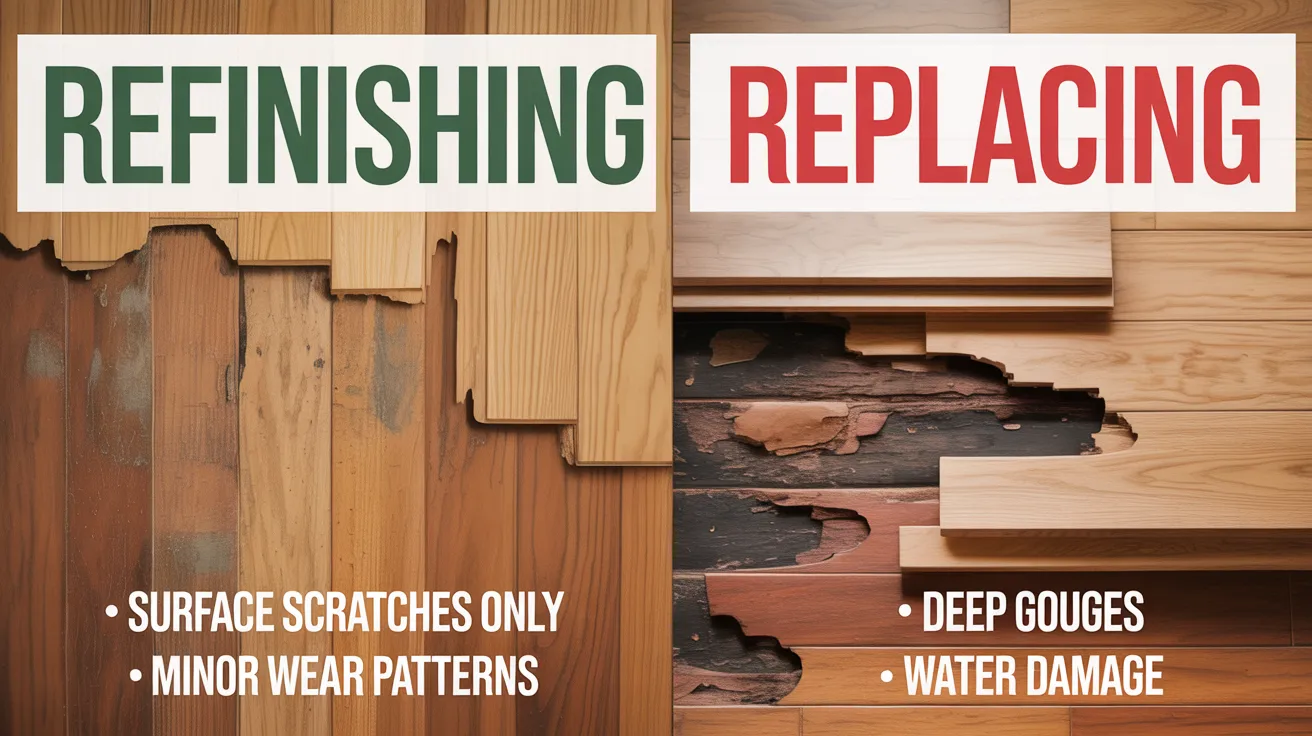
I’ve been refinishing hardwood floors in Atlanta for years, and the most common question I get is some version of this: “Do I need to replace these floors, or can you save them?” The honest answer is that most floors can be saved. But not all of them. Knowing the difference before you call anyone will save you time, money, and a lot of stress.
Here’s how to figure it out yourself.
First Things First: What Kind of Floor Do You Actually Have?
Before you start testing scratches, you need to figure out what you’re working with. Not every floor that looks like hardwood actually is hardwood, and the type you have changes everything.
Start with your foundation. If your home is built on a concrete slab, there’s a very good chance your floors are engineered hardwood, laminate, or luxury vinyl plank (LVP). Solid hardwood is rarely installed directly on concrete. If your floors turn out to be laminate or LVP, refinishing is off the table entirely. Those materials can’t be sanded. Your only option is replacement.
If your home has a raised foundation with a subfloor underneath, you’re more likely to have solid hardwood, but you still need to confirm. The easiest way to check is to pull up a floor vent or register. Look at the edge profile of the board. If it’s a solid chunk of wood all the way through, typically 3/4 inch thick, you’ve got solid hardwood and refinishing is absolutely on the table. If you see thin layers glued together, that’s engineered hardwood, and you’ll want to be much more careful.
This one step can save you from calling a contractor out only to find out your floors aren’t candidates for refinishing at all.
The Quick Visual Test
Start by just looking. Get down on your knees with a flashlight angled low across the floor surface. This raking light trick reveals everything.
Surface scratches are the fine, shallow marks from pets, furniture, or years of foot traffic. They sit in the finish layer, not the wood itself. Refinishing removes these completely.
Deep gouges are different. These cut into the actual wood fiber. You can feel them with your fingernail. Depending on how deep and how widespread they are, refinishing can still fix most of these with some filler work, but severe gouging sometimes means individual board replacement.
Fading and discoloration from sun exposure or heavy traffic patterns is completely normal after 10 or 15 years. That’s just the finish aging. Refinishing brings everything back to a uniform color and sheen.
Gray or black spots are typically one of two things. Gray typically means the finish has worn away completely and you’re looking at bare, unprotected wood. Black spots are a sign of moisture damage, usually from a water leak, a flower pot sitting too long, or animal urine. The location and shape of the spot can give you a good clue about what caused it. Either way, these need closer inspection before you commit to refinishing.
The Water Drop Test
This is the simplest test you can do, and it takes about 30 seconds.
Put a few drops of water on the floor in a high-traffic area. Watch what happens over the next minute or two.
If the water beads up, your finish is still doing its job. The floor may look dull or scratched, but the protective layer is intact. You probably don’t need to do anything urgent.
If the water soaks in and darkens the wood, the finish has worn through. The bare wood is exposed and absorbing moisture every time someone mops, spills a drink, or tracks in rain. That’s when refinishing becomes necessary, not optional.
The Middle Ground: Buff and Recoat
There’s an option between doing nothing and doing a full refinish that a lot of homeowners don’t know about. It’s called a buff and recoat, sometimes called a screen and recoat.
If your floors are solid, the color still looks good, and there are no deep scratches or gouges, but the finish just looks a little tired or faded, a buff and recoat might be all you need. The process lightly scuffs the existing finish with a buffer, cleans everything up, and applies one fresh coat of polyurethane on top.
It’s much less abrasive than a full sand. There’s almost no dust, the process is usually done in a single day, and the cost is generally about half of what a full refinish would run. For floors that just need a refresh rather than a full restoration, it’s the smart move.
The catch? It only works if the existing finish is still mostly intact. If the water drop test showed the wood absorbing moisture, you’ve gone past the point where a buff will help. You need a full refinish.
When Refinishing Will Save Your Floors
Refinishing is the right call in more situations than most homeowners expect.
Surface scratches and general dullness are exactly what refinishing is designed to fix. The sanding process removes the old finish along with all the wear, and the new coats bring back the color and sheen.
If you want to change your stain color, that’s also done during refinishing. Going from a golden oak to a dark walnut, or lightening up an old dark floor, is completely achievable.
One thing a lot of people don’t realize: most solid hardwood floors can be sanded and refinished 4 to five times over their lifetime. If your floors have never been refinished, you almost certainly have plenty of wood left to work with.
The cost comparison here is significant. Professional refinishing typically runs $3 to $5 per square foot. Full replacement of hardwood floors runs $9 to $15 or more per square foot, depending on the species, installation complexity, and the region of the property. On a 1,000 square foot floor, that’s the difference between $5,000 and $12,000. Refinishing is almost always worth exploring first.
When Replacement Is the Only Option
Sometimes the damage is beyond what sanding can fix. Here are the situations where replacement is the honest answer.
Warped, cupped, or buckled boards that won’t lie flat are a sign of serious moisture damage. While mild cupping can often be sanded flat during a refinish, warping and buckling are a different story. Those boards have permanently deformed and need to come out.
Extensive water damage with mold underneath is non-negotiable. You can’t sand over a mold problem. The subfloor and affected boards have to come out, the mold has to be addressed, and then you can reinstall.
Floors that are too thin to sand again are more common in older homes that have already been refinished multiple times. Remember that floor vent trick from earlier? Use it again here. If the board looks noticeably thinner than the standard 3/4 inch, it’s been sanded before and may not have much wood left to work with.
The nail test is a quick field check. If you can see nail heads poking up through the surface, the wood has worn down to the point where the fasteners are exposed. That floor is done.
Structural damage to the subfloor is also a replacement trigger. If there’s flex or bounce when you walk, the problem isn’t the hardwood, it’s what’s underneath. No amount of refinishing fixes a bad subfloor.
The Humidity Factor for Southern Homeowners
This section matters more if you’re in Atlanta, Savannah, Charlotte, or anywhere else in the Southeast with real summers.
Humidity is the number one enemy of hardwood floors in this region. When wood absorbs moisture from the air, it expands. When it dries out in winter with the heat running, it contracts. Do that cycle enough times and you’ll see cupping, gapping, and cracking that has nothing to do with foot traffic or age. Before any new floor installation, the wood needs to acclimate in your home for several days. Skipping that step is one of the most common reasons new floors develop problems within the first year.
On the maintenance side, keeping your HVAC system maintained and running a whole-home dehumidifier during peak summer months does more to protect your floors than any finish product. Try to keep indoor humidity somewhere between 35 and 55 percent year-round.
What About Engineered Hardwood?
If you did the floor vent check earlier and saw layered construction, you’ve got engineered hardwood. The wear layer on top determines whether it can be refinished at all.
Most engineered floors can only be refinished one time if you’re lucky, maybe two times if it’s a 3mm veneer, but others can’t be touched at all. The threshold is generally around 2mm of veneer thickness. Anything under that and sanding risks cutting through to the core material underneath.
The safer option for engineered hardwood, especially on slab foundations, is a buff and recoat. Instead of sanding down to bare wood, you lightly scuff the existing finish and apply a fresh topcoat. It won’t fix deep scratches or change the stain color, but it restores the sheen and adds protection for a few more years at a fraction of the cost.
If you have engineered hardwood that’s damaged in isolated spots, replacing individual planks is often better than attempting a full refinish. A good contractor can sometimes source matching boards and blend the repair so it’s nearly invisible.
Making the Call
Here’s the bottom line. If your floors are dull, scratched, or faded, there’s a very good chance refinishing will make them look brand new at a fraction of replacement cost. If you’re seeing structural issues, deep water damage, or floors that have already been sanded thin, replacement is the smarter long-term investment.
When you’re not sure, get a professional assessment. A contractor who’s been doing this a while will look at your floors and tell you honestly whether refinishing makes sense or whether you’d be throwing money at a problem it can’t solve. If you’re in the Atlanta area and want a straight answer, this team specializes in professional hardwood floor refinishing and will give you an honest read before any work begins.
The floors in most homes have more life left in them than their owners realize. A good sanding and refinish can add another 15 to 20 years. It’s worth finding out before you commit to a full tear-out.
