

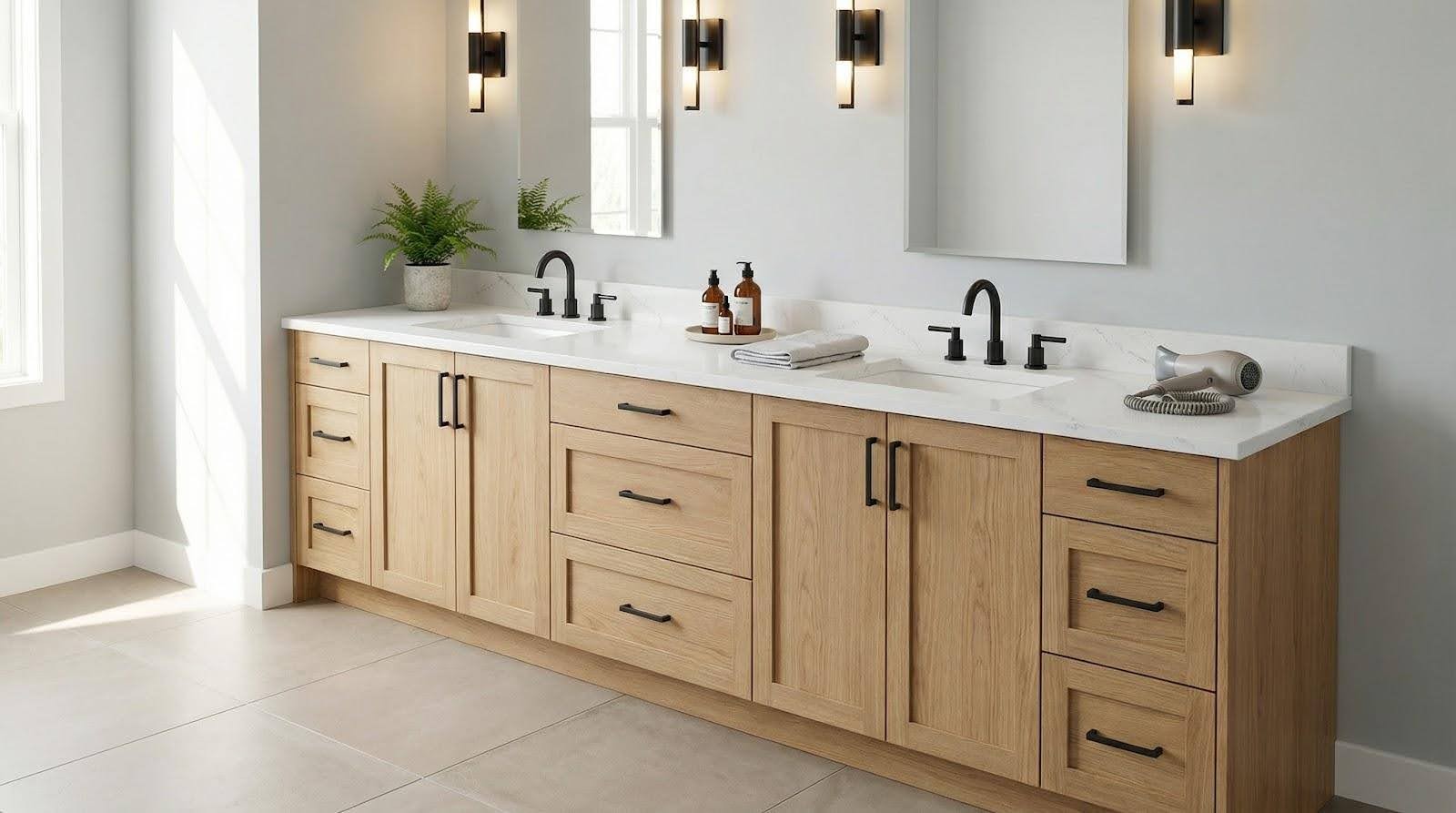
Imagine stepping into your bathroom and greeting seven feet (84 in./2.13 m) of solid hardwood—double sinks, smooth-glide drawers, and spa-level calm all in one line of cabinetry. In the next few minutes, we’ll show you how to choose the right size, spot real-wood construction, avoid hidden costs, and keep the finish flawless for years. Skim or dive deep—either way, you’ll walk away ready to order and install a vanity that feels tailor-made for your space.
Why choose an 84-inch solid-wood vanity?
An 84-inch solid wood double-sink vanity delivers spa-level calm, generous storage and everyday convenience in a primary bathroom
Seven feet (84 in./2.13 m) of counter space reshapes your morning routine. You can spread out hair tools, skin-care kits, and even a small plant without crowding the faucets. The width also leaves room for two undermount sinks—a feature that sixty-five percent of renovating homeowners now request in a primary bath, according to Houzz—so you and your partner can get ready side by side.
Storage scales up, too. Deep, full-extension drawers hide blow-dryers, and the center cabinets keep towels stacked neatly. In Houzz’s latest state-by-state report, vanities were the most-replaced element of a bathroom remodel, and sixty-two percent of buyers opted for custom or semi-custom cabinetry to unlock every inch of space.
Then there’s the material advantage. Solid hardwood shows real grain you can stain, paint, or refinish years from now—flexibility MDF cannot match. Real-estate agents say double-sink hardwood vanities act as a buyer magnet because they signal luxury, durability, and low maintenance.
Extra width plus genuine wood means a calmer bathroom today, and stronger resale value tomorrow—no compromise required.
Solid wood vs. engineered alternatives
First, some definitions. Solid wood means the frame, doors, and drawer fronts are milled from hardwood such as oak, walnut, maple, or teak, not a composite plank wrapped in veneer. Open a drawer and you’ll spot dovetail joints, three-quarter-inch sides, and soft-close slides: cabinet-shop hallmarks, not flat-pack shortcuts. Retailers like Willow and Bath Vanity build their 84-inch double-sink models with the same dovetail joinery and soft-close hardware, so you can order factory-fresh pieces that meet cabinet-shop standards without paying custom prices.
Solid hardwood vanity boxes with dovetail joints stay crisp under bathroom moisture, while MDF cores and thin laminates are more prone to swelling and peeling over time
Engineered panels like MDF or particleboard serve a purpose in budget cabinets, yet moisture is their weakness. In a 2020 lab study, MDF samples swelled about seven percent in thickness after a twenty-four-hour water soak. Steam from daily showers can create similar stress, forcing seams apart and letting laminate peel.
Health is another divider. Under U.S. TSCA Title VI, composite wood may emit up to 0.11 ppm formaldehyde for MDF and 0.09 ppm for particleboard, still higher than the zero ppm released by true hardwood. Premium vanity makers avoid the issue by sealing solid wood with low-VOC, water-based finishes.
Durability also tips the scales. A kiln-dried hardwood box, sealed on all sides, resists humidity and can be sanded, stained, or repainted years later, something a veneered core cannot survive.
There are trade-offs. Solid wood weighs more and costs more. An eighty-four-inch oak vanity with a quartz top can reach three hundred pounds, so you’ll need firm flooring and, often, professional installation. That weight, however, keeps the cabinet from flexing under stone, and the finish can be renewed instead of replaced.
Bottom line: engineered wood trims the upfront price, while solid wood protects the vanity, year after humid year.
Size and space essentials
Before you fall for an eighty-four-inch vanity, verify that it will physically fit both your bathroom and the path to it.
A simple plan-view layout helps you confirm wall length, walk space, toilet clearance and doorway width before ordering an 84-inch solid wood vanity
- Wall length. The cabinet spans 84 in. (7 ft, 2.13 m). Leave at least 1 in. of breathing room on each end so doors or trim do not bind.
- Depth and walk space. Quality vanities project about 21 in. (533 mm). Plan a clear 30 in. (762 mm) in front so you can bend, open drawers, and still pass by, an NKBA guideline for lavatories.
- Toilet clearance. Keep 18 in. (457 mm) from the toilet’s centerline to the nearest cabinet edge. Anything tighter breaks NKBA best practice and feels cramped quickly.
- Plumbing rough-ins. Dual sinks need a second drain and extra supply lines. Check the spec sheet for exact locations before tile goes down, or you will be carving notches in drawers later.
- Delivery path. A pre-assembled hardwood box this size rarely pivots through 32-in. (813 mm) hallways. Measure every doorway, stair landing, and ceiling height along the route. If any opening is under 34 in. (864 mm), the NKBA accessible doorway width, order a split-base model or budget for professional movers.
Spend thirty minutes with a tape measure now and you can avoid a triple-digit return freight bill later.
Shipping and return policies for large vanities often make freight charges non-refundable and require that you send the cabinet back in its original crate. Willowbathandvanity.com states in its shipping and return information that shipping fees are not refunded once an order leaves the warehouse, that standard delivery is curbside, and that returns are accepted only for items in like-new condition within 30 days, which gives you a realistic picture of the stakes if an 84-inch solid-wood vanity does not fit.
Style and design options
Freestanding vs. floating
Most renovators still pick a floor-standing vanity because it offers maximum storage and lets the stone top sit directly on the subfloor. In Houzz’s latest Bathroom Trends Study, built-in or freestanding units account for eighty-eight percent of upgraded vanities, while just eleven percent are wall hung. The upside is stability; the drawback is visual bulk.
Freestanding vanities rest on the floor for maximum storage, while floating designs create an airy, spa-like look and make floor cleaning easier
Floating vanities create a lighter, spa-like look. The open toe kick makes the room feel larger and simplifies floor cleaning. Physics matters, though. Seven feet of hardwood and quartz can exceed three hundred pounds, so you will need solid blocking and professional installation.
Choose the style that fits your aesthetic, and the wall structure, before you fall in love with a specific finish.
Freestanding vs. floating.
Freestanding vanities rest on the floor like furniture, so the weight—often two hundred fifty to three hundred pounds once the stone top is installed—travels straight to the subfloor. That makes them easiest to set and anchor, and they deliver every cubic inch of lower-cabinet storage.
Floating models bolt to studs and blocking. The NKBA recommends at least two two-by-eight horizontal blocks or a continuous cleat rated for three hundred fifty pounds to carry a seven-foot vanity. The payoff is an airy, spa-like look and easier floor cleaning, but you trade away the bottom shelf and pay a pro for precision install.
We suggest choosing the style your wall can support, and your eyes will love, before you start comparing finishes.
Key features and functional add-ons
A few smart upgrades turn a big vanity into a daily pleasure, and recent Houzz surveys show homeowners are willing to pay for them.
Soft-close drawers with built-in power, organizers and subtle LED lighting turn a long vanity into daily quiet luxury
Soft-close everything. A quiet glide is more than a luxury sound bite. Eighty-two percent of renovating homeowners choose soft-close drawers, and seventy-three percent choose soft-close doors for their new vanity. Hinges cushion the doors, full-extension slides reveal the whole drawer, and the finish stays chip-free.
Built-in power. About thirty percent of buyers now specify concealed outlets or USB ports inside drawers. You can plug in razors, hair tools, or an electric toothbrush without cords snaking across the counter.
Drawer organizers. A solid twenty-seven percent add dividers or pull-out trays, so lip balm and charger cables stop vanishing into the back corners of a seven-foot cabinet.
LED accent lighting. Low-profile strips under the toe kick or inside drawers act as a night-light and help you spot the tweezers before coffee. They draw pennies of power and install with a peel-and-stick channel.
Each add-on nudges the vanity closer to custom furniture, without blowing up the budget.
Soft-close hardware: quiet luxury you feel every day
Slide a drawer shut with one finger and hear nothing. That hush explains why eighty-one percent of renovating homeowners pick soft-close drawers, and seventy-five percent choose soft-close doors for new vanities. The hidden piston slows momentum, so doors do not slam, finishes do not chip, and toddlers cannot pinch fingers.
Full-extension slides are part of the same upgrade. They pull the drawer completely past the face frame, so rogue hair ties or razor heads cannot hide in the back. On an eighty-four-inch vanity, often ten drawers deep, those whispers add up to calmer mornings and cabinetry that still glides like new after tens of thousands of cycles.
We encourage spending here once, because the hardware will keep proving its worth long after budget vanities start rattling.
Budget and cost breakdown
Online retailers list most solid-wood eighty-four-inch vanities between $1,400 and $3,700. Home Depot’s filter for this size even shows a $1,000 to $5,000 band, with many models clustered in the $1,500 to $3,000 range. Custom or designer lines can exceed $5,000, especially when you request premium woods such as walnut or teak.
Most of your 84-inch solid-wood vanity budget goes to the cabinet and countertop, but freight, installation and finish extras also add up
What moves the needle:
- Wood species. Maple or birch sits at the entry tier. White oak or acacia adds twenty to thirty percent, while walnut, teak, or rift-sawn oak can double the cabinet cost.
- Countertop material. Cultured marble starts around $15 per square foot, while Calacatta quartz averages $80 to $100 per square foot installed. A seven-foot vanity needs roughly twelve square feet of stone, so upgrading can add $700 to $1,000.
- Freight and delivery. A crated weight over three hundred pounds often requires less-than-truckload service, typically $250 to $450 curbside. White-glove delivery adds another $150 to $300.
- Installation and plumbing. Plan on $400 to $800 for setting the cabinet and connecting two sinks. Costs rise if supply lines must move.
- Finish extras. Faucets, mirrors, and a backsplash rarely come in the box. Budget $300 to $600 for two mid-range widespread faucets, plus $100 to $200 for a four-inch backsplash or tile.
Timing matters. Popular stains can sell out, and special-order quartz may run six to ten weeks. We suggest ordering early, padding ten percent for surprises, and spending where it shows. The cabinet greets you every morning, so it is the last place to cut corners.
Professional installation: why two hands are not enough
An eighty-four-inch solid-wood vanity is closer to a grand piano than to flat-pack furniture. The cabinet alone can weigh about 200 lb (91 kg). Add a quartz top and twin sinks, and you may steer 300 lb (136 kg) through doorways that measure only 30 in. (762 mm).
Pros use dollies, shims and careful leveling to move and secure a heavy solid-wood vanity without cracking the stone or stressing plumbing
That heft is the first reason to hire help. Pros arrive with shoulder straps, padded dollies, and the know-how to pivot long objects without marking drywall. Once inside the bath, your installer checks the floor for level, then shims the base so every corner carries weight evenly. Skip that step and a stone top can crack under its own mass.
Plumbing is the second hurdle. Two basins need twin drains plus hot- and cold-water lines precisely aligned with drawer cut-outs. A licensed plumber roughs the lines at the right height before the vanity slides in, then seals each faucet and trap against future leaks.
Cost is modest insurance. HomeAdvisor lists the average vanity installation at $1,500, with most homeowners paying $300 to $2,200, depending on size and plumbing work. Compare that with replacing a cracked quartz slab or repairing a hidden leak, and professional labor looks like a bargain.
Safety rounds out the case. A loaded vanity can tip if toddlers climb open drawers. Pros anchor the cabinet to studs with hidden L-brackets and run a bead of silicone so splashes never sneak behind. Those extra hands, and the insurance they carry, turn a half-day struggle into a polished, worry-free install.
Maintenance and daily care
Wood rewards a simple routine.
A quick daily wipe around the faucet keeps a solid wood vanity’s finish looking fresh for decades
- Every day. After brushing your teeth, wipe stray water around the faucet with a soft microfiber towel. Even small puddles can creep past the finish if they sit too long.
- Once a week. Swap the towel for a damp cloth and a drop of mild, non-abrasive soap. Glide over doors and drawer fronts, then dry right away. Cleaners that contain bleach, ammonia, or grit can cloud lacquer and polyurethane finishes. Wood Magazine notes these solvents break down cured coatings over time.
- Every shower. Switch on the bath fan to vent steam before it can swell joints or fog the mirror. In humid climates, a plug-in dehumidifier on a thirty-minute timer offers cheap insurance.
- Every six months. Open each drawer, snug loose pulls with a hand screwdriver, and inspect the finish. If it looks dull, buff on a thin coat of paste wax. Furniture experts recommend waxing no more than twice a year to prevent buildup and maintain water repellency.
Treat your vanity like fine furniture, and it will repay you with decades of service.
Pros and cons at a glance
Pros
- Hardwood frames resist warping and can carry a two hundred fifty-pound (113 kg) stone top.
- Surfaces can be sanded or repainted years later, extending the life span.
- Double-sink width eases morning traffic and lifts resale value; bathroom remodels return about sixty to seventy percent of their cost on average.
Cons
- Costs more up front, and solid walnut can be twice the price of MDF.
- Loaded weight, about three hundred pounds (136 kg), often calls for professional movers and installers.
- Daily wipe-downs are essential; skip them, and even premium finishes may cloud over time.
Conclusion
We recommend hardwood if long-term durability and spa-level style rank high on your list. For a quick, budget refresh in a home you plan to leave soon, a lighter engineered cabinet could make more sense.
Frequently asked questions
Is an eighty-four-inch vanity too big for my bathroom?
Probably not if you have at least 84 in. (7 ft, 2.13 m) of clear wall and 30 in. (762 mm) of walk space in front. Both figures match NKBA layout guidelines.
Do most eighty-four-inch models include two sinks?
Yes. More than ninety percent of vanities this wide are drilled for dual basins, according to filter counts at major retailers such as Home Depot and Wayfair.
How much does freight delivery cost?
Plan on $250 to $450 for a three-hundred-pound pallet shipped curbside. White-glove placement can add another $150 to $300.
Can I add my own countertop?
Absolutely. Many brands sell a cabinet-only SKU. Confirm the top size, typically 84 × 22 in. (2.13 × 0.56 m), and sink-cutout spacing before your fabricator starts cutting stone.
Will solid wood warp in a humid bathroom?
Quality hardwood is kiln-dried below eight percent moisture content and sealed on all sides, so warping is rare if you run the exhaust fan and wipe splashes promptly.
How long will it take to arrive?
In-stock finishes ship in about two to three weeks. Custom colors or special-order quartz tops may extend lead time to six to ten weeks, so we advise ordering early.
Can I refinish the vanity later?
Yes. Lightly sand the clear coat, apply new stain or paint, then reseal. A weekend of careful work can give the cabinet a fresh look without replacing a thing.
