

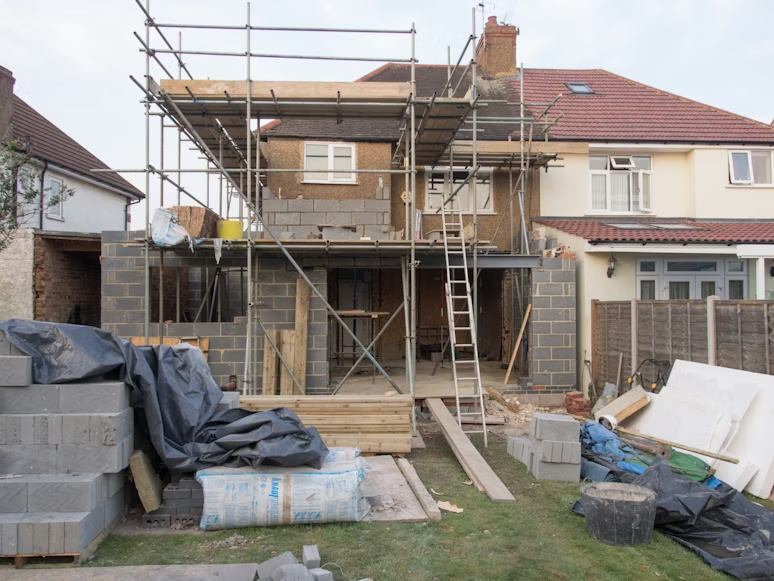
Few events in life can match the excitement and joy that springs forth from watching your new home stand tall from the ground up. Watching the construction process is strangely cathartic, as it mimics the act of becoming.
At first, there is only raw space and emptiness. Gradually, lines and marks appear that begin to take the form of a recognizable structure. Stud by stud, beam by beam, the upright frame offers comfort in watching a structure emerge where there was none.
Now, the catch here is that two people with the same vision and budget can end up with a drastically different home. This may be in terms of aesthetics, functionality, or both. Well, that’s because home construction decisions are not limited to the floor plan. This article will share three of them that matter a lot more than the layout.
The Right Builder
Perhaps no decision is more important than that of the professional you select to build your home. This one choice in itself will determine how well the chosen materials and layouts come together.
Keep in mind that the builder’s experience, attention to detail, and project management approach affect not only the overall costs but also the structure’s quality.
Plus, it’s the builder who will guide the planning and design process. Reliable ones take time to understand the homeowner’s long-term vision during early consultations. As Deaton Builders notes, this includes discussing preferred architectural style, flow, and other features that support daily living.
Such choices carry further weight in active housing markets like Asheboro, North Carolina. This city’s median home value has stayed in the mid-$270,000 to $290,000 range. It’s a sign of steady demand and promising residential development.
In a market where homes move at a healthy pace, working with a top local builder ensures the construction process is not rushed or haphazard. For new home construction Asheboro residents can trust, the focus should extend beyond price comparisons.
A well-qualified builder brings familiarity with local permits, inspection standards, soil conditions, and more. So, while you’re evaluating builders, consider asking these questions:
- How many projects have they completed?
- Can they provide recent client references?
- How are scheduling and subcontractor networks managed?
- What quality control measures are built into each phase?
- What type of warranty or post-construction support is offered?
Integrity of the Foundation
Like they say, the stronger the integrity of the ground beneath the home, the more secure the structure built over it. Long before you think of paint colors or finishes, focus on the integrity of the foundation.
In 2024, nearly 73% of new single-family homes in the US were constructed on slab foundations. This type of foundation tests directly on prepared soil. This means the condition of the soil, as well as the preparation of the site, is extremely crucial.
If the ground beneath is not well-prepared, no matter how aesthetic the home is, it will suffer from cracking and moisture issues over time. As a homeowner, what can you do? Well, ask the right questions to ensure the foundation your home will rest on is solid and secure. Before construction even begins, ask the following:
- Was a professional soil test conducted to understand its load-bearing capacity?
- How will the ground be compacted before the foundation is poured?
- What measures will be in place to ensure water drains away from the home?
- Will moisture barriers be installed wherever necessary?
- Is the chosen foundation type suitable for the area’s soil and climate?
For homeowners, the construction decision regarding the foundation is not about technical specifications. With this one choice, you will be on the right side of indoor air quality and energy efficiency. Plus, your home is less likely to require costly structural corrections later on.
The Framework Behind the Wall Design
Once the foundation is set, another decision that can make or break your home is that of the strength of its walls. Your home will also be fleshed out over its skeletal framework. Behind the drywall, there is a network of structural members that will hold up the roof and transfer weight down to the foundation.
So, ensuring this framework is strong enough is not optional. Plus, you’re not alone in making this decision. In 2024 itself, an estimated 1,364,100 new housing units were constructed in the US. Ongoing residential activity across the country shows that many homeowners face the exact same choice during the construction process.
Two homes with identical floor plans can behave differently simply due to their wall framework. After all, it is this part that determines how well your home resists the elements and supports its weight over time.
As a result, it’s worth understanding what contributes to such structural strength. As a homeowner, consider asking these questions:
- What grade of lumber will be used for the framing?
- How far apart are wall studs spaced?
- Are load-bearing beams sized in accordance with the spans they must support?
- How will the roof trusses protect against wind and seasonal stress?
- What types of fasteners and connectors will be used?
With the direct answers to these questions, you will also get explanations for what’s happening and why. Be assured that these structural standards can prevent issues like wall cracks and sagging ceilings down the line.
Those who have witnessed their home come to life, piece by piece, know that this process demands the patience of a saint. The reason why you and so many others still choose it is that it’s meant to be worth it in the end.
That’s the key takeaway here: a well-constructed home is seldom the result of a single good decision. It is the outcome of a chain of thoughtful ones. Hopefully, this article has started that chain with three of the most important ones. So, are you ready for the home of your dreams?
