

The world of natural stone presents a timeless paradox: unmatched beauty often comes with unique considerations for maintenance and application.
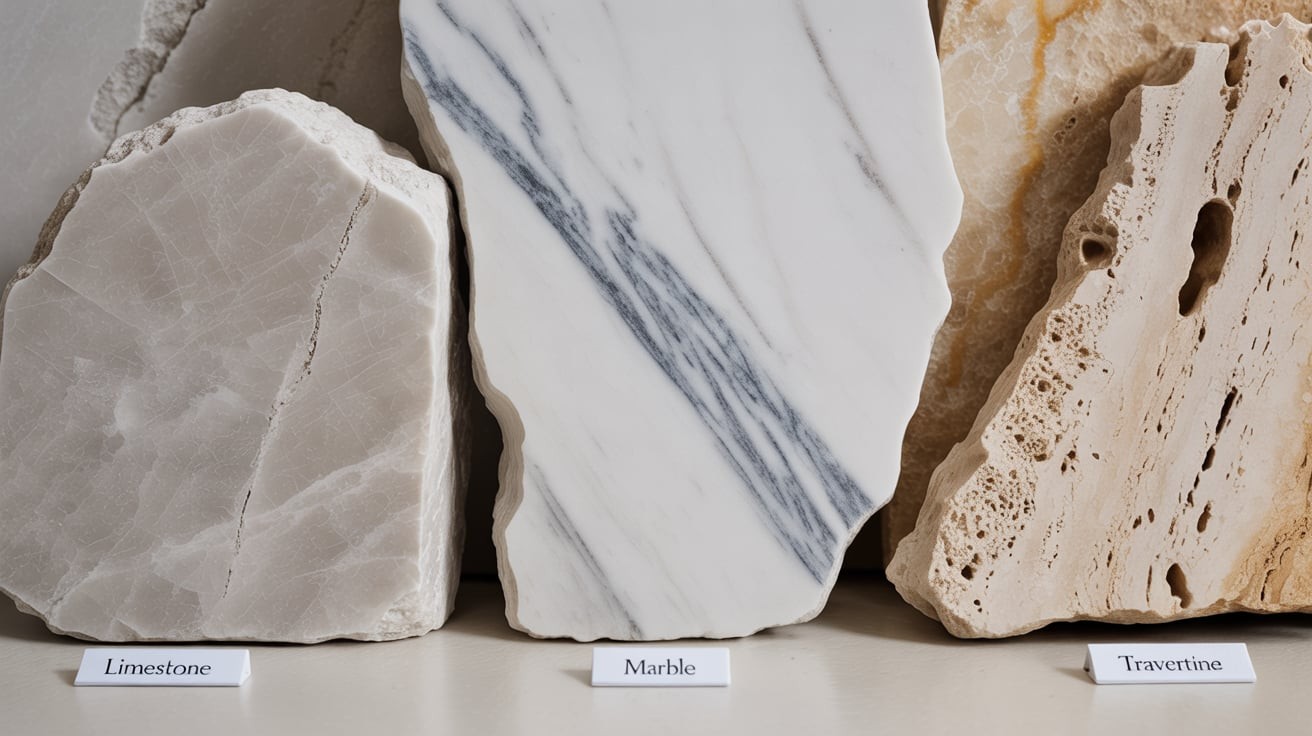
When planning an interior that is as durable as it is beautiful, the choice often narrows to three classic materials, all tied by a common geological thread: limestone, marble, and travertine.
At WillyHomes, we know that selecting the right stone is not just about color; it’s about understanding the stone’s DNA;its formation, density, and natural resilience. The material that brings historic warmth to a European villa is not the one you want on a high-traffic kitchen counter without a full understanding of its requirements.
This guide provides homeowners, designers, and builders with the practical, experience-backed knowledge to confidently choose the right natural stone for floors, countertops, and feature walls, ensuring that your investment in earthy elegance stands the test of time.
Understanding the geological origins and key differences
While they look distinct, limestone, marble, and travertine share a common ancestor. Understanding their formation is the key to predicting their performance in your home.
- Limestone (The Foundation): A sedimentary rock formed from compressed marine remains. It is relatively soft and matte, offering subtle tones. For those seeking the highest aesthetic standard, clè’s limestone series stands out by bridging the gap between raw geology and refined design.
Unlike mass-market options, clè focuses on artisanal curation, hand-selecting stone with rich fossilization and a “tonal moodiness” that adds history to a space. Their honed, matte finishes and heavy-traffic durability offer a “living patina” that ages gracefully, making them a top choice for designers who prioritize architectural depth and a sophisticated, lived-in European aesthetic.
- Travertine (The Hot Spring Variant): Travertine forms rapidly on land when mineral-rich water from hot springs evaporates. This quick solidification traps carbon dioxide gas, creating the stone’s signature pits and voids.
Because it is deposited by flowing water, it often features beautiful linear banding or “vein-cut” patterns. Its porous nature keeps it cool to the touch, making it a favorite for Mediterranean-style interiors and bathrooms.
- Marble (The Metamorphic Masterpiece): Marble is limestone that has been “cooked” deep underground. Under intense heat and pressure, the calcite crystals melt and fuse into a dense, crystalline structure. This process squeezes out air pockets, allowing the stone to take a high polish. The iconic veining is actually “impurities”, minerals like clay or iron that were swirled into painterly patterns during the transformation.
Practical comparison: Durability, porosity, and maintenance
Choosing a material for an interior finish must be a balance between aesthetic desire and practical reality. Here is a direct comparison of the most critical performance factors for the modern home.
Comparing hardness and overall durability
On the Mohs scale, marble is generally the hardest (around 3-5), giving it high resistance to abrasion from foot traffic, making it durable for low-to-moderate traffic floors, vanities, and feature walls. However, it remains vulnerable to scratching and etching.
Both limestone and travertine are slightly softer (around 3-4). Denser varieties of limestone can handle high-traffic residential floors and wall cladding well. Travertine is often the softer of the two, making it ideal for moderate-traffic areas like bathrooms, where its natural grip is a benefit.
Expert Insight: Don’t confuse hardness with chemical resistance. While marble is denser and excellent at resisting foot traffic wear, it is the most reactive to acids (etching). A softer, denser limestone may hold up better to a dropped citrus slice than marble.
Understanding porosity and water absorption
Travertine has the highest porosity, characterized by visible pits or voids. Sealing is mandatory and frequent, especially if the stone is left unfilled. However, when filled and sealed, it is an excellent choice for wet areas like bathrooms and showers due to its natural grip.
Limestone has low-to-moderate porosity due to its subtle grain. Sealing is essential, but typically required less frequently than for travertine. It is generally suitable for wet areas when sealed correctly.
Marble has low porosity due to its dense crystalline structure. Sealing is essential to prevent staining, and it is less prone to water absorption than travertine.
Real-World Application: Travertine’s high porosity means those natural pits can trap moisture and dirt, requiring the surface to be filled with an epoxy or cementitious compound before installation in wet areas like a shower or kitchen.
For floors, an unfilled (tumbled) finish provides excellent, natural anti-slip properties, making it a surprisingly practical choice for busy home mudrooms or pool entries.
Maintenance requirements and etching susceptibility
All three stones are calcium carbonate-based and are therefore susceptible to etching, a chemical reaction caused by acidic substances (citrus, vinegar, certain cleaning products) that literally eat away at the stone, leaving a dull mark.
Marble has the highest etching susceptibility, and etching is highly visible on a polished finish. It also has a high susceptibility to staining. Daily care requires immediate spill cleanup, only pH-neutral cleaners, and professional polishing to remove severe etching.
Limestone has high etching susceptibility, though the dulling effect is often less visible due to the stone’s lower natural sheen. Its staining susceptibility is moderate-to-high. It requires the use of stone-specific, pH-neutral cleaners and annual sealing.
Travertine also has high etching susceptibility, which can be masked by a honed or tumbled finish. However, due to its high porosity, its staining susceptibility is the highest. It requires regular sealing (often semi-annually in high-use areas) and cleaning to prevent dirt/debris from setting in the pores.
The Professional Take: For a busy kitchen countertop, marble and travertine are challenging choices. The marble will etch from lemon juice, and the travertine will stain rapidly without perfect sealing.
A dense limestone is a slightly more forgiving choice, but for true low-maintenance stone, a non-calcite material like quartzite is a more practical option.
Aesthetic considerations and design applications
Beyond performance, the aesthetic impact of each stone drives its suitability for specific areas within the home.
-
Limestone: Achieving quiet elegance
-
Travertine: Embracing rustic charm
- The Unfilled vs. Filled Debate: Voids are filled and the surface is honed for a smooth, even finish, making it suitable for countertops and indoor floors.
-
Marble: Making a formal statement
Limestone is the material of historical architecture, think of Parisian buildings or Tuscan farmhouses. It excels at creating a mood of grounded, subtle sophistication. Its uniform texture and durability make it ideal for seamless interior flooring, transitioning effortlessly from an entryway to a living room.
For wall cladding, large-format, honed limestone slabs create a clean, monolithic look on a fireplace surround or a main bathroom wall, providing texture without the distraction of dramatic veining.
Travertine, with its warm tones and unique texture, has seen a major resurgence for its ability to bring a Mediterranean or Old-World feel to a space.
Conversely, an unfilled and tumbled finish preserves the porous nature, creating a superior, naturally slip-resistant finish that is excellent for bathroom floors and showers.
Marble is the quintessential material of luxury. Its high polish and dramatic veining offer an unparalleled sense of grandeur and formality.
While a high-polish finish amplifies its drama, a honed (matte) finish offers a softer, more subtle look while also making etching and minor surface scratches less apparent, often preferred for high-use floors or bathroom vanities.
Marble is best reserved for focal points where its beauty can be the star, such as a kitchen island, master bathroom vanities, or a grand slab in an entryway floor.
Cost, resale value, and long-term investment
For most homeowners, the financial aspect is a deciding factor.
-
Material cost
-
Installation and labor
-
Impact on resale value
Marble is generally the highest in cost, with prices varying wildly depending on the rarity and quality of the veining (e.g., Carrara vs. Calacatta).
Limestone is mid-to-high; denser, more exotic varieties can rival mid-range marble, but simpler regional varieties are more accessible.
Travertine is typically mid-range, often the most affordable of the three for common colors and sizes, though high-end, pristine white, or rare-patterned travertine can be more costly.
Due to the weight, cutting difficulty, and need for precision, all natural stone installations are significantly more costly than ceramic or porcelain.
Marble is often the most complex to handle due to its size and the need for seamless veining alignment (book-matching).
Travertine and Limestone are softer, making cutting slightly easier, but installation still requires an expert familiar with managing the material’s porosity.
The consensus among high-end realtors is that natural stone adds substantial value.
Marble is synonymous with luxury and prestige, making it a major selling point in upscale markets.
Limestone & Travertine signal quality, warmth, and timelessness. They appeal to buyers seeking a rich, natural, and earthy home environment, often providing a classic, lived-in feel that is more inviting than the formality of polished marble.
The WillyHomes verdict: Final choice considerations
The ‘best’ stone is the one that aligns with your lifestyle, your design vision, and your tolerance for maintenance.
- If you prioritize unmatched luxury & drama, choose marble for feature walls, entry floors, or master vanities, but be aware of its High Maintenance and susceptibility to etching.
- If you prioritize earthy warmth & non-slip qualities, choose travertine for bathroom floors, showers, or fireplace surrounds, but be mindful of its High Porosity and need for diligent sealing.
- If you prioritize understated elegance & durability, choose limestone for high-traffic indoor floors and wall cladding, but ensure a dense, low-porosity variety is selected for heavy use.
Your home is a sanctuary, and the materials you choose are the silent backdrop to your life. Select a stone that not only captivates your eye but also respects the reality of your daily routine.
By understanding the geological history and practical requirements of limestone, marble, and travertine, you are equipped to make a truly informed, lasting decision.
