

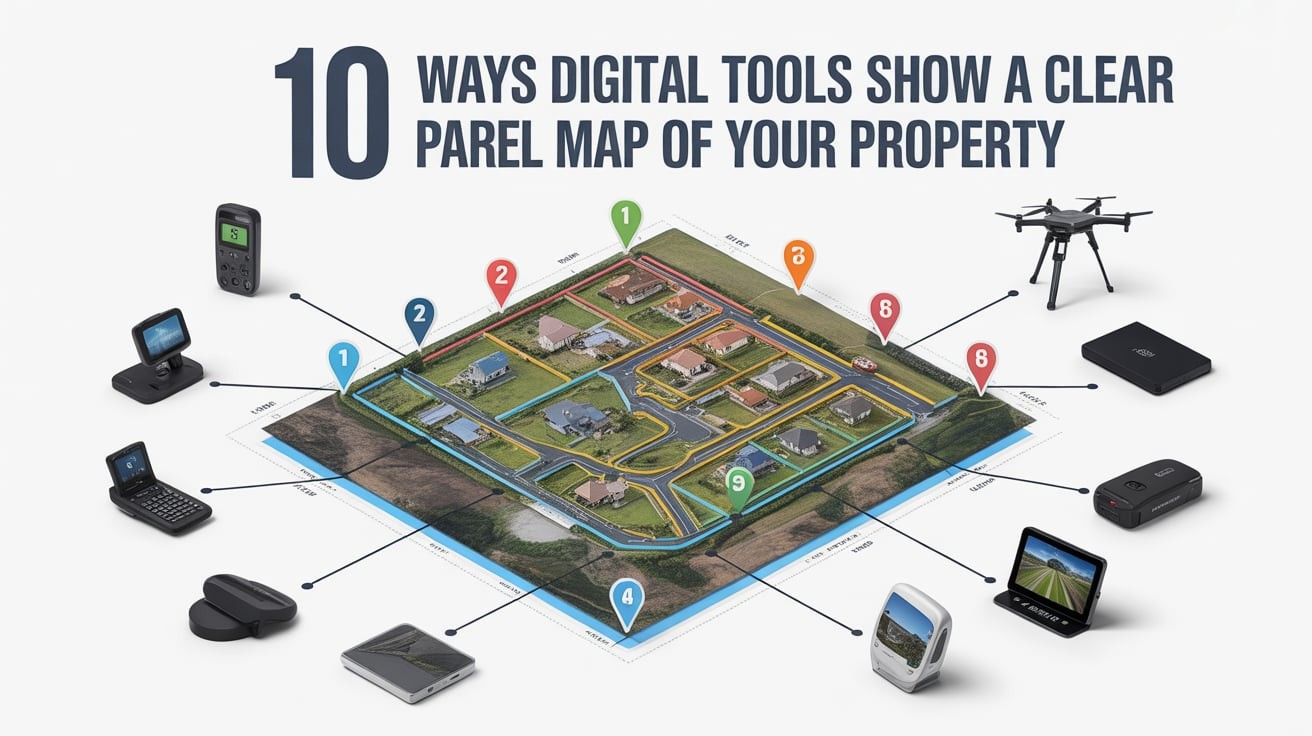
For many property leases, understanding residential property lines can be challenging. Precise information is essential for making informed decisions. Now, there are accessible solutions through digital tools. Parcel maps and easy-to-understand property information are available on these platforms. Effective mapping leads to fewer disputes, improved planning, and greater certainty. Below are the top ten ways digital tools enhance parcel maps, making them crystal clear to property owners.
Satellite Imagery Enhances Visual Clarity
These digital platforms provide outlines of properties using images from advanced-resolution satellites. These images show not only borders but also neighbouring structures and features. The owner can now see lines on their property more clearly. It prevents any confusion since the owners can compare the maps on the screen with the land. The boundaries are as easy to spot as a satellite object can be, of course. Viewing a digital parcel map of my property makes it easier to understand the exact boundaries and divisions of my property.
Interactive Maps Offer Customization
Several digital tools include interactive maps. They enable users to zoom in, pan around, and select particular parcels. Customize the Property Types to have different views for each property type. With a few taps, owners can showcase specific fences or distances. To escape the vagueness around layouts, interactive functions come in handy, making them clearer and more appealing to the user.
Overlay Features
Overlay choices combine historical maps with modern ones. These comparisons illustrate the evolution of lines. Users will be able to see changes to property lines or neighboring parcels. Having this transparency helps ensure that misunderstandings about past and present limitations do not occur. Providing useful overlay features promotes better decision-making for the development and maintenance.
Search Functions Simplify Parcel Identification
The advanced search functions enable users to search for parcels by either address or coordinates. Quick searches replace time-consuming manual checks. As a result, it minimizes mistakes and annoyance. If owners want to know about a particular plot in the land registry, they can easily find out. Search tools enable rapid mapping capabilities without requiring you to leave the mapping workflow.
Measurement Tools Provide Accurate Dimensions
With more accuracy, users can measure area and perimeter. These are essential for work related to construction, fencing, or landscaping. Measurements are exact, which also gives owners confidence. When data is accurate, the planning and budgeting will have fewer errors. Features of measurement save time and avoid expensive mistakes.
Availability Of Legal Descriptions
Many digital mapping platforms display a legal description for each parcel. Legal diction should clarify lines unambiguously. Mapped lines can be paired with legal definitions, enabling owners to verify the accuracy of the lines. It also assists dispute resolution between neighbours. Trustworthy reference points allow seamless transactions and transitions of ownership after the fact.
Mobile Access Increases Convenience
Mapping tools with a mobile-friendly interface enable users to access parcel maps from anywhere. And the convenience branches out when the owner can access the particulars during the site picnic. Updates can be executed on the fly due to mobile options. Rapid access to back decisions in the moment. With portable technology, information about the property is always at hand.
Integration With Public Records Adds Reliability
There are even some tools that link directly to your public land records. Maps are updated with the latest information thanks to linked data. Accurate information about taxes, zoning, and ownership is a valuable asset for owners. Integration ensures that we don’t work with old maps. With trusted records, there can be less contention and peace of mind.
Topography and Utilities on Layered Data
Digital platforms typically display data in layers, including topography, utility lines, and other relevant information. These layers are useful for owners planning construction or landscaping projects. Where there are slopes, water lines, or power routes, it avoids costly mistakes. Layered maps provide an in-depth view of the property ecosystem. With better data, you can make more informed decisions about the property.
Sharing and Collaboration Features Improve Communication
Parcel maps generated by most digital mapping tools can be shared with others. Maps can be sent to surveyors, architects, or neighbors by the owners. Features to enable collaboration, making it easier for all parties involved to agree on boundaries and plans. Open communication reduces conflicts and strengthens trust. Collaborative tools promote cooperation and clarity.
Conclusion
With the advent of technology, property lines are seen and interpreted differently than before. Satellite images, interactive maps, and search functions provide clarity and ease of use. Overlay features help users compare changes over time, and legal descriptions prevent inaccuracies. Solid measurements lead to well-planned measures, and access to information anytime and anywhere ensures the user. Additional reliability and detail come from integration with public records and layered data.
